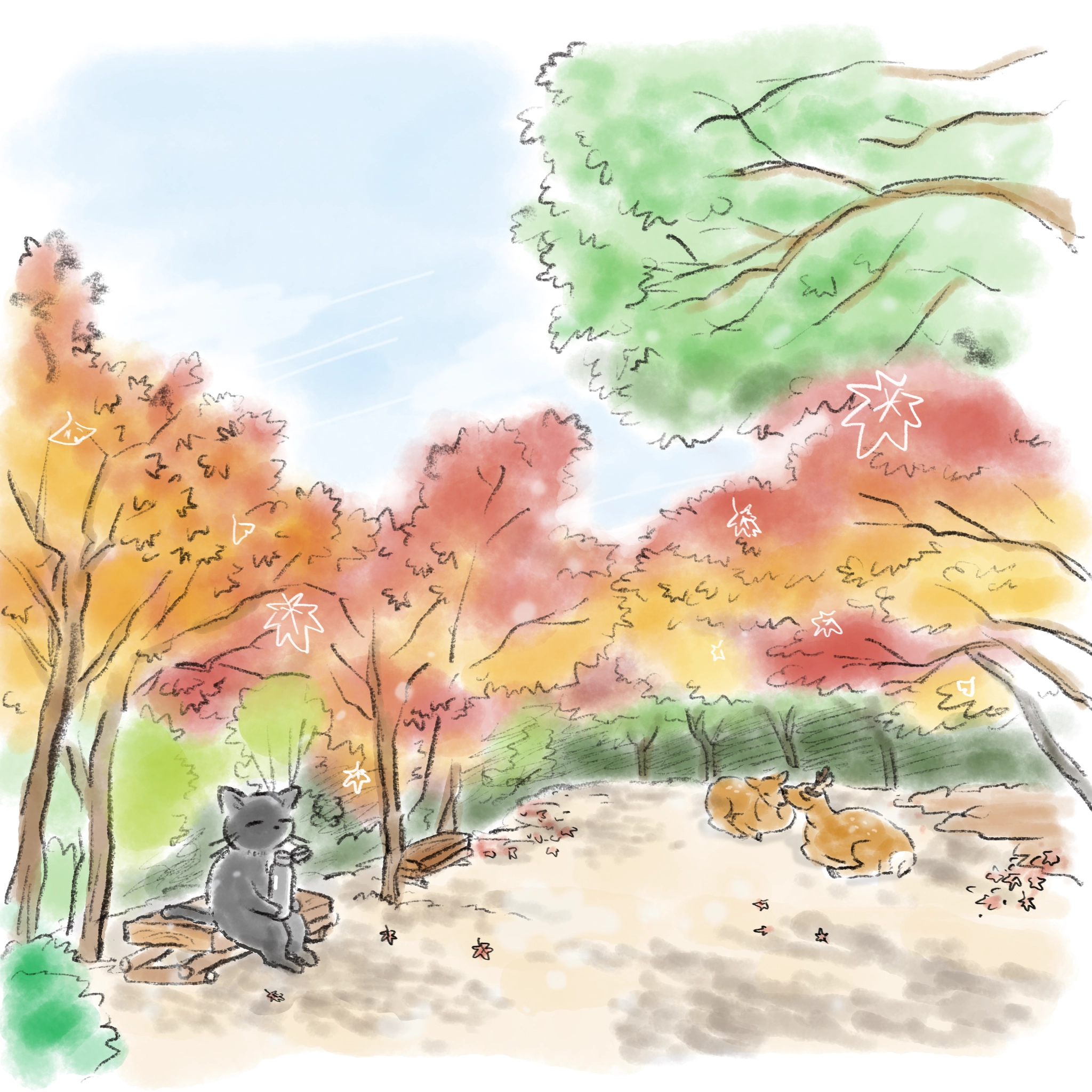
The Day I Became Familiar with Miyajima. Years after that day my husband was shy, two deer and I relax in Momijidani in autumn.
#Nature
My great-grandmother was from Miyajima, they say.
When I told my uncle I was marrying someone from Hiroshima and moving from Tokyo to Hatsukaichi City, where Miyajima is located, he suddenly brought up this story.
“Even though she said she was from Miyajima, I don't know if she was actually from the island or nearby, but she herself said she ‘came from Miyajima.’ She apparently came here with my grandfather, who was a timber merchant in Kiba, Tokyo.”
My uncle thought that my great-grandmother might have been a former geisha or something, always smoking a long kiseru pipe, and when she got angry, she would tap it sharply against the brazier,
“Warya, taigai ni see ya! (*You, stop it already!)”
…I don't know if she actually said that, but according to my uncle, the way she sharply retorted in "some kind of amazing Hiroshima dialect," which he couldn't quite understand, was apparently terrifying.
“Back then, she was taken from Miyajima to Tokyo, and now you’re being taken from Tokyo to there,” my uncle said with deep sentiment, and my father, who was young at the time and had no memory of his great-grandmother, and my mother, who was hearing such a story for the first time, listened with open mouths.
I was surprised too, but the loneliness of going to a place with no connections or ties felt a little bit soothed.
Well, there were some ties after all.
When I went to my husband's parents' house in Hatsukaichi for our marriage greetings, I truly thought it was a land with no connections or ties. I remember feeling light and uneasy on my feet when my husband showed me around Miyajima.
We walked around the island, and he said, "A little further on, there's a place called Momijidani," so we decided to extend our walk and go there.
But it was winter, and the essential maple leaves had all fallen.
“It wasn't the season now. Of course,” my husband said, showing a shy smile.
For my husband, who meticulously calculates everything before acting, to go to Momijidani without any maple leaves, he might have been a little nervous, perhaps because he was showing his hometown to his future wife for the first time. He said, "Let's come again in autumn," and we left the place.
Where did that fresh young man from back then go? My current husband says, "Locals don't bother going to Miyajima during the autumn foliage season amidst heavy traffic," so we hadn't been able to revisit.
I was able to go to Miyajima in autumn a few years ago when I happened to visit for work. I had been cooped up indoors working for a while and hadn't noticed, but seeing the autumn leaves on the island, I realized it was autumn. After work, I had some time, so I decided to go to that Momijidani valley.
To be precise, it's called Momijidani Park.
The small vermilion bridge at the entrance, which had been a desolate sight when my husband and I visited, was now immediately adorned with vibrant autumn colors.
Inside, maples and Japanese maples were competing in their autumn colors. The vivid red foliage at its peak is beautiful, but it's also interesting to see the transition of the seasons, with red leaves gently framing the translucent yellow ones.
Walking while enjoying the leisurely swimming carp in the pond and a small waterfall, it felt like a good workout after a long time.
Amidst a pleasant fatigue, I sat on a bench and drank coffee from my thermos. A little distance away, two deer were sitting together, huddled close. Miyajima deer don't mind people being nearby. The two deer, I, and the three of us shared a quiet resting time. The autumn sun warmly illuminated the red maple leaves.
It suddenly occurred to me.
What were Miyajima's autumn leaves like in my great-grandmother's time? Did she ever walk around the island with the local gentry to see the autumn colors? How long have the maples, now so vibrantly colored, been there?
In any case, I've become so familiar with Miyajima that I can relax with the deer without feeling uncomfortable, even when my husband isn't by my side. After all, I know Miyajima in autumn, which is said to be the busiest time of the year.
I felt proud of that.
Text
RIE NAKAJIMA
A writer who spent her childhood in Chiba, Niigata, and Osaka before wandering through Tokyo and abroad, eventually settling in Hatsukaichi, Hiroshima Prefecture, her husband's hometown. She has been told that her great-grandmother was from Miyajima, so she likes to think that, in a way, she has "come back." In her free time, she enjoys visiting cat cafés with her daughter and exploring local sweets.